
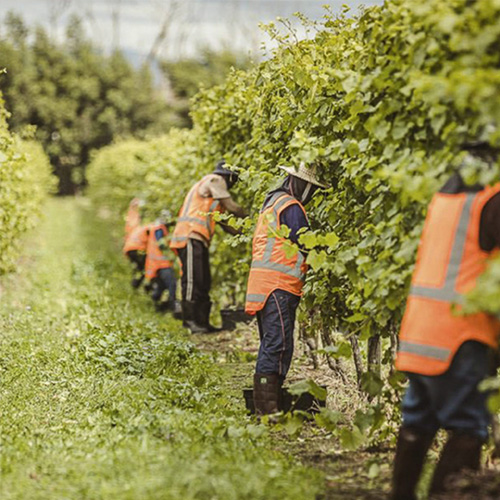
AgriSmart’s task management tools make it easy to assign, track, and complete work across your farm. From seasonal harvests to daily maintenance, you can monitor progress in real time, allocate responsibilities to the right team members, and ensure nothing is missed. Keep your workflow organised, your team aligned, and every task visible in one central dashboard.
RSE Payroll Compliance Software for New Zealand Horticulture Employers
The 120-hour four-week test, the 30-hour average, returning-worker rates, top-ups, and deductions, calculated automatically from approved timesheets every pay period.
Last reviewed: May 2026
Regulatory basis: Immigration New Zealand RSE Instructions WH1.20, effective 1 April 2026

How AgriSmart calculates the RSE four-week minimum remuneration rule
Technical calculation
How AgriSmart calculates the RSE four-week minimum remuneration rule
AgriSmart uses approved payroll and timesheet data to monitor each worker against the required four-week minimum remuneration threshold.
01
Pulls approved timesheets by employee.
02
Groups hours into employer-selected or rolling four-week periods.
03
Calculates total paid hours.
04
Compares against the 120-hour benchmark.
05
Applies the relevant per-hour rate.
06
Identifies shortfall where minimum remuneration is not met.
07
Produces employee-level audit records.
RSE compliance support
RSE compliance requirements covered by AgriSmart
AgriSmart helps RSE employers monitor key pay, hours, deduction and accommodation requirements with practical reporting and clear audit records.
30-hour average over four weeks
Basis: INZ RSE changes and WH1.20.5
AgriSmart: Four-week averaging report
120-hour minimum remuneration test
Basis: WH1.20.5
AgriSmart: Automatic threshold monitoring
Minimum wage and third-season worker rates
Basis: WH1.20.5
AgriSmart: Returning-worker rate detection
Piece rate and hourly rate consistency
Basis: WH1.20.1 and WH1.20.15
AgriSmart: Piece-rate and hourly comparison
Pay deductions
Basis: WH1.20.10
AgriSmart: Deduction tracking and audit trail
Accommodation cost recovery
Basis: WH1.20.20 to WH1.20.22
AgriSmart: Accommodation deduction records
Official sources
Government and legislative references
These official government and legislative resources outline the employment, wage, payroll and worker protection requirements relevant to RSE employers in New Zealand.
Worked examples
How the RSE four-week rule works in practice
These simplified examples show how AgriSmart checks worker hours across a four-week period and identifies whether the minimum remuneration rule has been met.
Example 1
Standard four-week period
| Week | Hours |
|---|---|
| Week 1 | 32 |
| Week 2 | 28 |
| Week 3 | 31 |
| Week 4 | 29 |
| Total | 120 |
Outcome: compliant.
Example 2
Weather disruption
| Week | Hours |
|---|---|
| Week 1 | 35 |
| Week 2 | 20 |
| Week 3 | 28 |
| Week 4 | 30 |
| Total | 113 |
Outcome: AgriSmart identifies a seven-hour shortfall and calculates the required top-up.
Example 3
Returning third-season worker
Where a worker is identified as third season or later, AgriSmart applies minimum wage plus 10% as the minimum actual-hours rate.
Outcome: the worker is assessed against the higher applicable minimum rate.
How AgriSmart helps
AgriSmart RSE payroll compliance functions
AgriSmart includes practical payroll and compliance tools designed to help RSE employers monitor worker pay obligations, deductions, remuneration thresholds and reporting requirements.
RSE worker classification
Returning-worker season count
Minimum wage plus 10% rate rule
Four-week averaging period selection
120-hour shortfall detection
Piece-rate and hourly-rate reconciliation
Minimum remuneration top-up calculation
Paid break recording
Accommodation deduction tracking
Audit-ready worker-level reporting
Payroll calculation history
IRD Payday Filing support
Stay fully compliant with the 2024/25 RSE rules
Automated tracking, accurate payroll, and audit-ready reports.
Frequently Asked Questions
What are the RSE rules for minimum hours?
RSE employers must provide an average of 30 hours of paid work per week, calculated across a four-week period rather than each week in isolation. Over four weeks that totals 120 hours. The averaging gives flexibility for weather and seasonal fluctuation while still guaranteeing the worker a minimum level of pay.
Do employers need to provide 30 hours every week?
No. The requirement is averaged over four weeks, not measured per week. A lighter week can be balanced by a heavier one, as long as the four-week total meets the minimum.
What happens if an RSE worker receives less than 120 hours over four weeks?
The employer must top up the worker’s pay to meet the minimum remuneration for the period. AgriSmart identifies the shortfall, calculates the exact top-up required, and records it with full audit detail.
Do returning workers have to be paid more?
Yes. Workers returning for their third or subsequent season must be paid at least 10% above the New Zealand adult minimum wage. All other RSE workers must be paid at least the minimum wage. AgriSmart detects returning workers by season count and applies the higher rate automatically.
Does AgriSmart calculate minimum wage and top-ups automatically?
Yes. AgriSmart compares each worker’s pay against the applicable minimum, including piece-rate and hourly reconciliation, and calculates any top-up needed, automatically and with a full audit trail.
What happens when workers start partway through a four-week cycle?
AgriSmart excludes days before the worker’s start date from the averaging calculation, so a mid-cycle start does not produce a false shortfall against the 120-hour benchmark.
How does AgriSmart help with RSE compliance overall?
It tracks hours, units, wages, top-ups, returning-worker rates, deductions, and four-week averaging in one connected system, producing audit-ready records for each worker.
- Payroll
- Timesheets
- Ticketing & Traceability
- Digital Hiring
- Rosters
- Health & Safety
- Task Management
- Spray Diary
- Equipment Register

Timesheets
Staff record time effortlessly with our iOS and Android app, even offline. For added flexibility, hours can be entered manually or through biometric devices in the shed. Every entry flows into payroll and rosters, giving you accurate pay runs, better scheduling, and a clear record of hours worked.
Need More Info?

Ticketing & Traceability
Purpose-built for horticulture, our bin ticketing system brings accuracy and control to your harvest. Track every bin from block to shed with full visibility over quantities, picker performance, and bin movements. Improve harvest efficiency, reduce waste, and strengthen quality control, all while keeping costs in check.
Need More Info?


Rosters
Build and share rosters in minutes with AgriSmart’s scheduling tools. Assign the right people at the right time and keep everyone updated instantly through the mobile app. Staff see shifts as soon as they are published, reducing confusion and last-minute calls. Approved changes flow into timesheets and payroll, keeping your team clear, records accurate, and compliant.
Need More Info?


Spray Diary
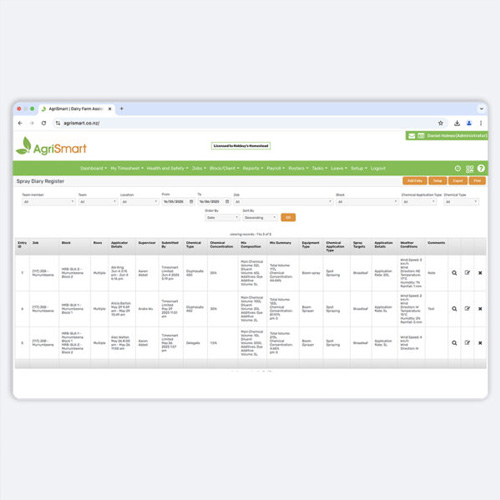
Designed for horticulture, our spray diary makes it easy to log chemical applications, including sprays, fertigation, and dry treatments. Record details once, stay audit-ready, and meet compliance standards with less admin. The system keeps records accurate, centralised, and field-ready for reliable reporting.
Need More Info?
Equipment Register
Keep tools, vehicles and machinery organised in one digital system. Track photos, details, documents and servicing in structured asset profiles. Set automated maintenance reminders, store full histories and keep equipment compliant, safe and ready to work across every site.
Need More Info?