
AgriSmart’s task management tools make it easy to assign, track, and complete work across your farm. From seasonal harvests to daily maintenance, you can monitor progress in real time, allocate responsibilities to the right team members, and ensure nothing is missed. Keep your workflow organised, your team aligned, and every task visible in one central dashboard.
RSE Workforce Compliance
Four-week averaging, returning-worker rates, top-ups, and deductions, monitored automatically for every RSE worker on your books.
The RSE rules leave no room for interpretation: a 30-hour average across every four-week period, 10% above minimum wage from a worker’s third season, and deduction records that hold up when INZ asks. AgriSmart applies all of it as time is recorded and flags exceptions before payroll closes, so your accreditation never rides on a spreadsheet.
120+
Hours rules applied
100%
Workforce visibility
Audit-ready
RSE records


4-Week
Hours

Payroll
Top-Ups

Returning Worker Rates

Deduction Records

Audit-Ready Evidence
ONE PLATFORM. COMPLETE CONTROL.
Everything you need to manage your workforce in one place
Build and manage shifts quickly
Track time and attendance in real time
Automate timesheets and approvals
Seamless payroll integration
Stay compliant with labour laws and awards
Powerful reporting and insights

BUILT FOR THE REALITIES OF HORTICULTURE
Seasonal. Variable. Unpredictable. We get it
Whether it’s sun, rain or last minute changes, AgriSmart gives you the flexibility to adapt fast and keep your operations moving.
Reduce risk, stay compliant
Built in compliance tools help you meet labour laws, track visa conditions and keep accurate records with confidence.
More time for what matters
Save hours on admin, reduce payroll errors and give your team the tools they need to do their best work
Can you prove every RSE hour, rate, and deduction?
RSE employers need more than completed timesheets. You need clear, connected records that show who worked, what they worked on, how they were paid, and which deductions were applied. Without that visibility, payroll becomes harder to trust and compliance becomes harder to defend.

If the records are not connected, the risk stays with you
Hours worked do not match payroll calculations
Piece-rate units are not clearly linked to worker time
Wage top-ups are checked manually
Returning worker rates are easy to overlook
Deduction records are difficult to explain
Compliance reviews turn into a document hunt
Six RSE areas employers need under control
RSE compliance is not just about knowing the rules. Employers need clean records across hours, pay, deductions, worker movement, and payroll evidence, so every decision can be checked, explained, and produced when needed.
Minimum hours & 4-week averaging
RSE employers need clear visibility of paid hours across the required period, especially when weather, downtime, or late starts affect work patterns.
Need to prove
- Hours are recorded accurately each day
- 4-week averages are monitored before payroll closes
- Exceptions are visible before payroll closes

Piece rates & wage top-ups
Piece-rate and mixed-rate work needs to connect units, time, and pay so minimum requirements are not checked after the fact.
Need to prove
- Units are linked to worker time
- Earnings are checked against minimum pay requirements
- Top-ups are calculated and traceable

Returning worker wage uplift
Returning RSE workers need to be identified clearly so the correct wage rate is applied without relying on memory or manual checks.
Need to prove
- Worker history is visible
- Rate changes are applied at the right time
- Payroll decisions can be explained

Accommodation & deductions
Accommodation, service, and related deductions need clean records showing what was deducted, when, and why.
Need to prove
- Deductions are linked to the correct worker
- Payroll records match payslip deductions
- Evidence is ready if deductions are questioned

Movement & assignment history
When workers move between blocks, tasks, teams, employers, or regions, records need to stay connected to payroll and compliance.
Need to prove
- Worker location and assignment history is visible
- Task, block, and team movement is recorded
- Payroll uses the same source of truth

Audit-ready payroll evidence
RSE compliance depends on being able to produce clear records quickly, not rebuild them when questions come up.
Need to prove
- Timesheets, units, rates, deductions, and payroll records align
- Managers can review exceptions early
- Evidence is stored and easy to retrieve

Stay fully compliant with the 2024/25 RSE rules
Automated tracking, accurate payroll, and audit-ready reports.
Frequently Asked Questions
What are the new RSE rules for 2024/25?
The current RSE rules require an average of 30 hours of paid work per week across a four-week period (120 hours in total), with a pay top-up where that minimum is not met. Workers in their third or subsequent season must be paid at least 10% above the minimum wage, and there are updated accommodation cost rules and more flexibility for workers to move between employers and regions.
Do employers need to provide 30 hours every week?
No. The requirement is averaged over four weeks, not per week.
How does AgriSmart help with RSE compliance?
AgriSmart tracks hours, units, wages, top-ups, returning-worker rules, and four-week averages, giving employers the payroll checks and worker-level records needed to manage RSE compliance with confidence.
What happens when workers start mid-way through a cycle?
AgriSmart excludes days before the start date from the averaging calculation, preventing false compliance issues.
Does AgriSmart calculate minimum wage top-ups?
Yes, automatically and with full audit detail.
Do returning workers get higher pay?
Yes. Workers in their third season or later must receive 10% above minimum wage, and AgriSmart applies this automatically.
- Payroll
- Timesheets
- Ticketing & Traceability
- Digital Hiring
- Rosters
- Health & Safety
- Task Management
- Spray Diary
- Equipment Register

Timesheets
Staff record time effortlessly with our iOS and Android app, even offline. For added flexibility, hours can be entered manually or through biometric devices in the shed. Every entry flows into payroll and rosters, giving you accurate pay runs, better scheduling, and a clear record of hours worked.
Need More Info?

Ticketing & Traceability
Purpose-built for horticulture, our bin ticketing system brings accuracy and control to your harvest. Track every bin from block to shed with full visibility over quantities, picker performance, and bin movements. Improve harvest efficiency, reduce waste, and strengthen quality control, all while keeping costs in check.
Need More Info?


Rosters
Build and share rosters in minutes with AgriSmart’s scheduling tools. Assign the right people at the right time and keep everyone updated instantly through the mobile app. Staff see shifts as soon as they are published, reducing confusion and last-minute calls. Approved changes flow into timesheets and payroll, keeping your team clear, records accurate, and compliant.
Need More Info?


Spray Diary
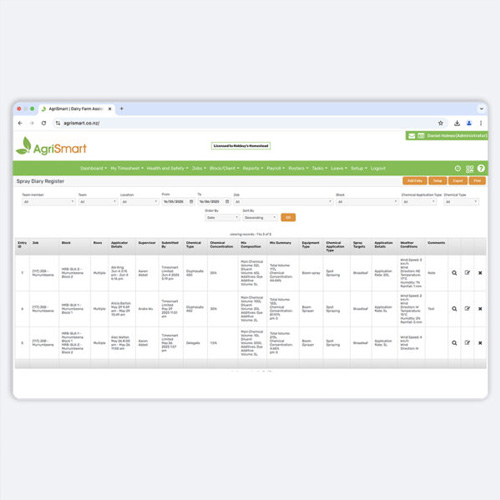
Designed for horticulture, our spray diary makes it easy to log chemical applications, including sprays, fertigation, and dry treatments. Record details once, stay audit-ready, and meet compliance standards with less admin. The system keeps records accurate, centralised, and field-ready for reliable reporting.
Need More Info?
Equipment Register
Keep tools, vehicles and machinery organised in one digital system. Track photos, details, documents and servicing in structured asset profiles. Set automated maintenance reminders, store full histories and keep equipment compliant, safe and ready to work across every site.
Need More Info?